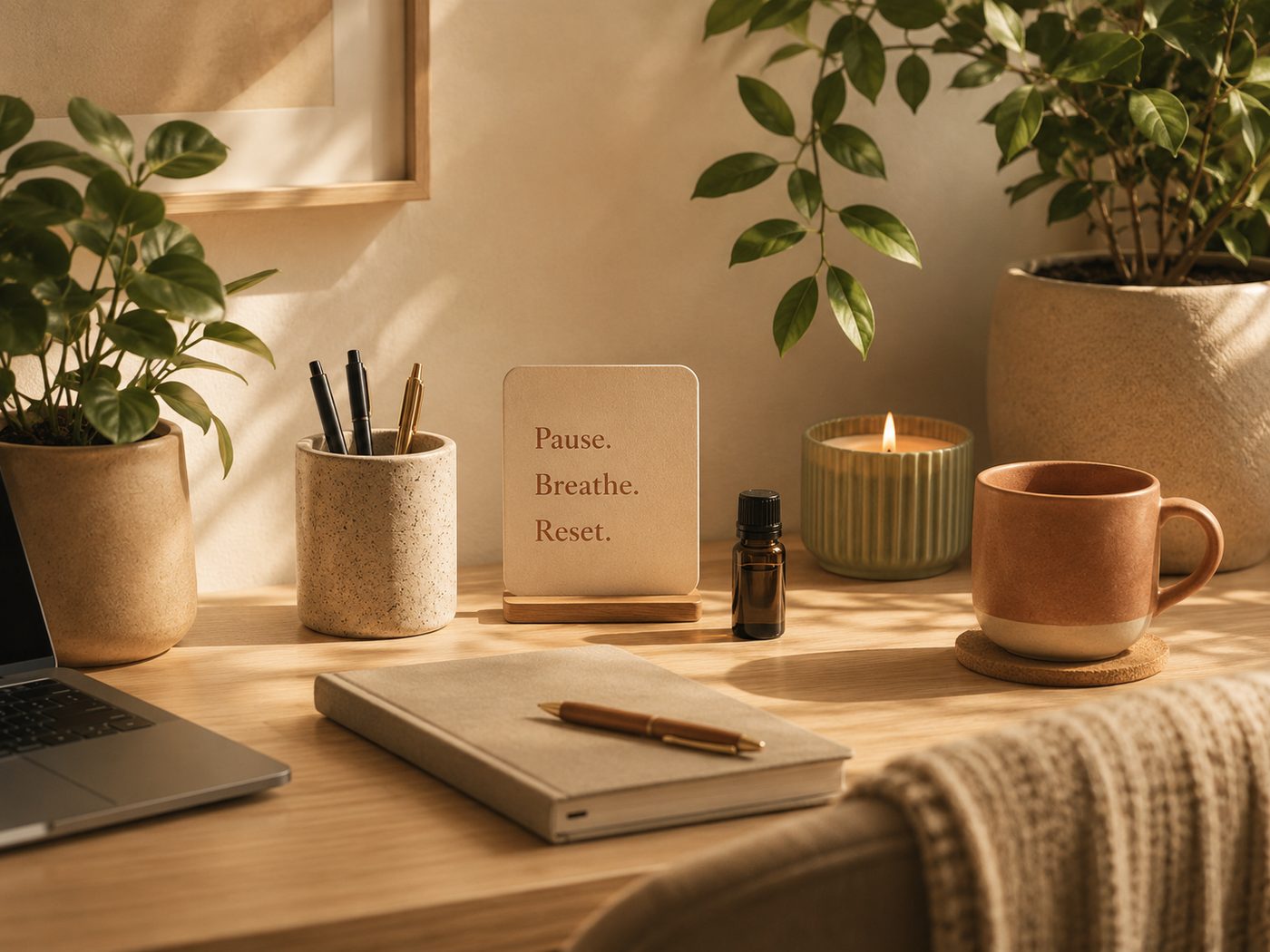
Search "stress relief desk accessories" and you'll get a wall of cute little gadgets — most of which end up in a drawer within a week. This list is the opposite: things worth keeping in reach because they actually do something during a stressful stretch of the day, whether that's a packed meeting schedule, a deadline, or just one of those days that feels harder than it should.
None of these replace an actual break or a walk outside — nothing on a desk can do that. But for the moments you're not going to step away anyway, these are worth having within arm's reach.
For your hands
1 A Fidget Tool
Sounds small, works well — something to do with your hands during a tense call or while you're thinking through a problem gives restless energy somewhere to go instead of building up. A fidget cube, tangle toy, or worry stone all work; pick whichever one is quiet enough for video calls.
- Near-zero cost, no real downside for most people
- Clicky versions can be distracting on video — test before a call
View on Amazon →
2 A Hand-Held Massager
For the shoulder and neck tension that quietly builds up from hours of screen time. A few minutes between meetings makes a real difference — this is one of the few things on this list that addresses the actual physical tension, not just the feeling of it.
- Genuine physical relief, not just distraction
- Won't fix posture problems long-term — pair with a laptop stand
View on Amazon →
For the room
3 A Small Diffuser
You don't need to be "into" essential oils for this to work. It's really a scent cue — your brain learns to associate a specific smell with "focus mode" or "wind-down mode," which makes it easier to shift between them. Citrus scents for focus, lavender for winding down, is the usual starting split.
- Cumulative effect — gets more useful the longer you use it consistently
- Won't do much the first few uses — it's a habit tool, not instant relief
View on Amazon →
4 A Small White Noise Machine
Useful if you share your space with a partner, roommates, kids, or a dog that barks at every delivery truck. Consistent background sound also just makes a room feel calmer than dead silence for a lot of people — worth trying even if noise isn't your main issue.
- Masks unpredictable noise, which is more stressful than steady noise
- Some people find constant sound distracting rather than calming — worth testing first
View on Amazon →
For your body
5 A Weighted Lap Pad
A smaller, desk-friendly version of a weighted blanket. Gentle, even pressure across your lap can genuinely take the edge off during a tense stretch of work — no need to leave your desk or explain to anyone why you have it.
- Works while you keep typing — unlike most stress tools
- Can run warm — check for a breathable fabric if you tend to overheat
View on Amazon →
6 A Hand Cream You Like Using
Small, easy to overlook, and genuinely nice — a hand cream you actually enjoy the smell and feel of turns a two-second habit into a tiny pause during a busy day. Keep it right next to your keyboard so it's easy to actually use.
- Lowest-effort item on this whole list
- Let it absorb before typing — obvious, but easy to forget
View on Amazon →
For pacing your day
7 A Visual Timer
Not a stress toy, but genuinely stress-reducing: a simple timer for focused work blocks (25–50 minutes) takes the guesswork out of "when do I get to stop for a second," which is often what makes a task feel more draining than it needs to be.
- Addresses a completely different kind of stress than the other items — planning anxiety, not physical tension
- Only helps if you actually respect the timer when it goes off
View on Amazon →
Which one to actually start with
If you're only trying one thing, start with the fidget tool (#1) or the timer (#7) — they're the cheapest, and they address two very different kinds of stress: restless energy in the moment, and the low-grade dread of an unstructured day. The rest are worth adding once you know which kind of stress shows up more for you.
FAQ: what people usually ask
Do desk stress accessories actually work, or is it placebo?
It's mixed, and worth being honest about. The hand-held massager works because it addresses real muscle tension — that's not placebo. The fidget tool and diffuser work more through habit and distraction, which is still a legitimate mechanism (redirecting nervous energy is a real coping strategy), just a different one than "physically fixing" the stress.
What's actually the difference between a weighted lap pad and a stress ball?
Different nervous system pathways. A weighted lap pad works through steady pressure (similar to why weighted blankets help some people sleep); a stress ball works through repetitive hand movement. If squeezing something doesn't do much for you, the lap pad is worth trying instead — they're not interchangeable.
I've tried stress balls before and they didn't help — what am I missing?
Probably nothing — some people genuinely don't respond to hand-fidgeting as a stress outlet. If that's you, the timer (#7) or the diffuser (#3) work through a completely different mechanism (structure and scent-association rather than physical fidgeting) and are worth trying before writing off desk accessories altogether.
More real-world finds
New picks get posted on Instagram alongside full guides.
Follow @stressfreeworkday