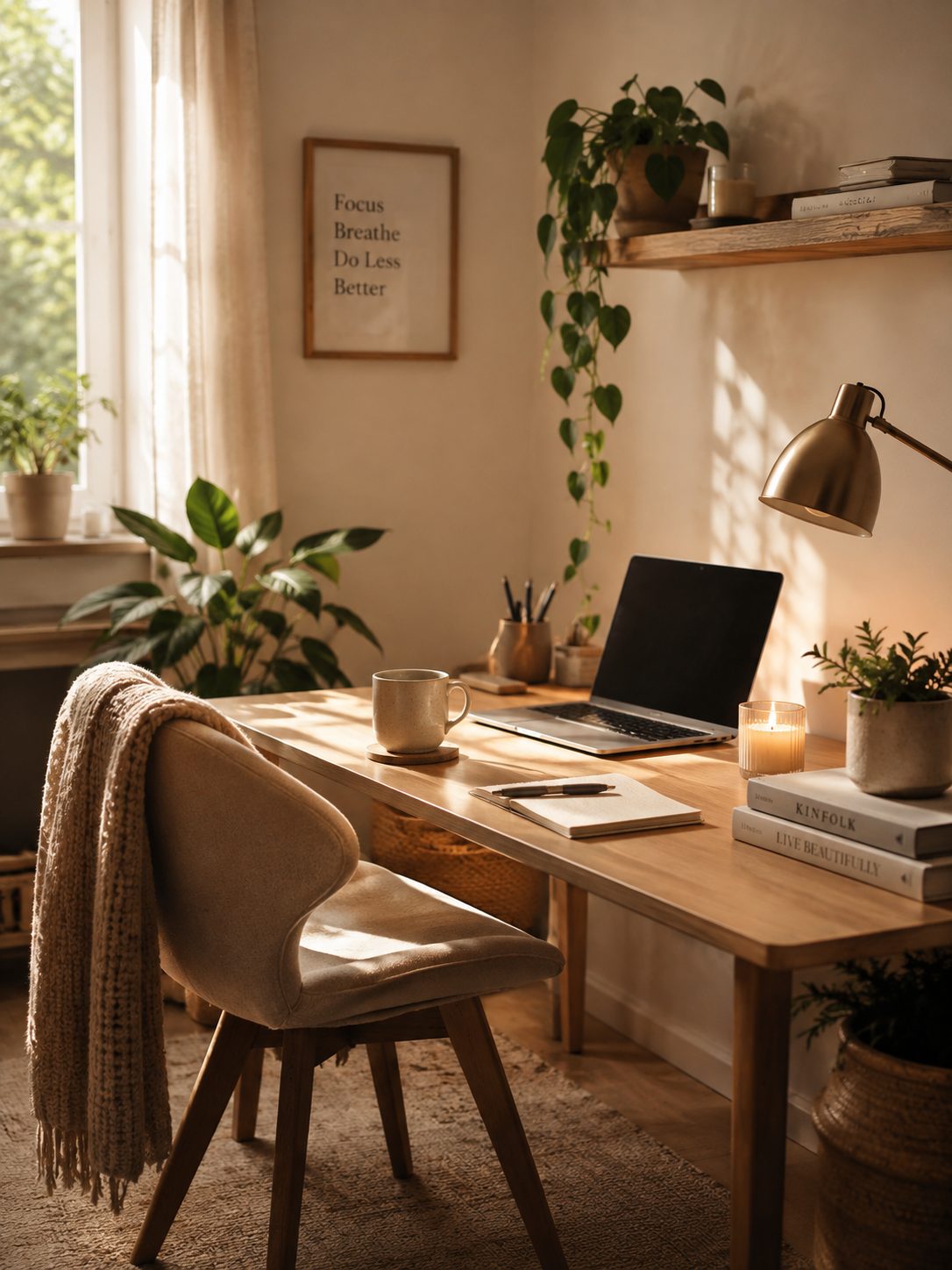
If you work from home — as an employee, a freelancer, or running your own thing — you've probably noticed that the space itself affects how the day feels. No commute, no office door closing behind you, no built-in transition — just the same room, the same chair, the same laptop, for however many hours the day needs.
A few thoughtful changes to that space can do a lot of the work for you: comfortable enough that your body isn't quietly tense by 3pm, cozy enough that you actually enjoy being there, and organized enough that visual clutter isn't adding to the noise in your head.
Skip to what you need: Comfort & Ergonomics · Cozy Decor · Stress Relief · Organization · FAQ
1. For comfort and ergonomics (the "my body hurts by 3pm" fix)
This is the category that pays off fastest. Most home-office stress isn't emotional — it's physical tension from bad posture and a body that's been in the same position for six hours straight.
1 Standing Desk Converter
You don't need a full electric standing desk to get the benefit — a converter that sits on top of your existing desk lets you switch between sitting and standing a few times a day. That alternation is what reduces stiffness, not standing all day (which just trades one kind of strain for another).
- Breaking up long sitting stretches
- No need to replace your whole desk
- Takes up desk depth when raised
- Cheaper ones can wobble — check weight rating
View on Amazon →
2 Ergonomic Wireless Mouse
Wrist strain builds so gradually you stop noticing it — until it's gone. A contoured, quiet-click mouse is a small daily comfort, and the quiet clicks matter more than you'd think once you're on back-to-back calls.
- All-day comfort at a low price point
- Quiet clicks for open-plan or shared spaces
- Vertical styles need a short adjustment period
View on Amazon →
3 Low-Profile Wireless Keyboard
Pair it with the mouse above. A slim, quiet keyboard is a small daily comfort — and if your video calls pick up your typing, your coworkers will notice too.
- Low desk footprint
- Quieter than most laptop keyboards
- Less tactile than mechanical keyboards
View on Amazon →
4 Laptop Stand
If you work straight off a laptop, your screen is too low — full stop. A simple stand that raises it to eye level is one of the cheapest posture fixes that exists. Pair with an external keyboard and mouse so your hands don't end up too high.
- Biggest posture improvement per dollar on this list
- Foldable options travel well
- Useless without an external keyboard/mouse
View on Amazon →
2. For cozy decor and ambiance (the "this room feels like a punishment" fix)
A workspace that looks like a waiting room makes it harder to want to sit down — and harder to feel calm once you do. None of this needs a redesign. Small, warm touches do most of the work.
5 Oversized Desk Mat
An easy way to visually "reset" a desk without buying new furniture. Pick a color that actually makes you happy to look at — this is the cheapest mood upgrade on this list.
- Instant look change, no tools needed
- Protects the desk surface too
- Light colors show coffee rings fast
View on Amazon →
6 Warm-Light Desk Lamp
Overhead lighting is functional but flat. A warm-toned task lamp gives your desk its own little pool of light — it reads as cozy instead of clinical, especially once it gets dark earlier in the evening.
- Softer light for evening work sessions
- Dimmable options double as mood lighting
- Warm light alone isn't enough for detail work — pair with overhead
View on Amazon →
7 Low-Maintenance Desk Plant
One plant. That's it. It doesn't need to be complicated — a small, hard-to-kill variety on your desk gives your eyes somewhere to land that isn't a screen.
- Pothos, ZZ plant, snake plant all survive neglect
- Some common varieties are toxic to pets — check first
View on Amazon →
8 Soft Throw Blanket for Your Chair
Small detail, real effect. Draped over your desk chair, it makes the whole setup feel less like a workstation and more like a space you'd choose to sit in.
- Doubles as literal warmth in a cold office
- Chunky knits shed — wipe down keyboard occasionally
View on Amazon →
9 A Mug (or Teapot) You Actually Love
This sounds minor until you notice how much of your day revolves around coffee or tea breaks. A mug you like using turns a two-minute break into an actual pause instead of just refueling on autopilot.
- Cheapest genuine "pause" on this whole list
- None, really — just pick one you like
View on Amazon →
3. For stress relief (the "I'm wired but can't stop" fix)
These won't replace an actual break, a walk, or setting a real boundary. But on the days you're not going to take that break anyway, having something within reach helps.
10 Hand-Held Massager
For the shoulder and neck tension that builds up from hours of screen time and stress-hunching toward your keyboard. A few minutes between calls makes a noticeable difference.
- Addresses actual physical tension, not just the feeling of it
- Corded models limit where you can use it
View on Amazon →
11 Stress Ball / Desk Fidget Tool
Simple, cheap, and genuinely useful during a tense call or while you're waiting for something to load. Keep it in reach, not in a drawer — the ones that get used are the ones sitting right next to the keyboard.
- Almost no cost, no downside
- Can be distracting on video if it's noisy — test before a call
View on Amazon →
12 Weighted Lap Pad
A smaller, desk-friendly version of a weighted blanket. Gentle, even pressure across your lap can take the edge off during a stressful stretch of the day — without needing to leave your desk.
- Usable mid-task, unlike a full weighted blanket
- Can feel too warm in summer — check the fabric
View on Amazon →
13 Small Essential Oil Diffuser
A quiet, low-effort way to change how a room feels. You don't have to be "into" essential oils for this to work — it's really just a scent cue that tells your brain "this space is different from the rest of the house."
- Builds a "focus mode" association over time
- Needs occasional cleaning to avoid mold buildup
View on Amazon →
4. For organization (the "visual clutter = mental clutter" fix)
You don't need a Pinterest-perfect desk. You need to stop seeing a tangle of cords and a pile of loose pens every time you sit down — because your brain registers that mess as one more unfinished task.
14 Woven Cable Management Box
Hides your power strip and the nest of cords behind it. It's a five-minute setup that removes a visual annoyance you've probably stopped consciously noticing — but it's still there, quietly bothering you.
- One-time fix, no maintenance after setup
- Check size against your power strip before buying
View on Amazon →
15 Daily Notepad + Small Pencil Organizer
A simple daily notepad — not a full planner, just today's priorities — keeps your actual to-do list out of your head and off fifteen sticky notes. Pair it with a small tray or cup to corral pens so they stop sliding around your desk.
- Cheap, low-effort mental-clutter fix
- Only helps if you actually use it daily
View on Amazon →
Where to start if you're not doing all 15 at once
You don't need to buy everything on this list. If you only do three things, do this: fix your screen height (#4), add one warm light source (#6), and clear the visual clutter (#14). Those three changes touch your body, your mood, and your mental load — the three things that actually add up to "stressful workday" in the first place.
FAQ: what people usually ask about setting this up
Do I really need a standing desk converter, or is that overkill?
Not required — it's the one item on this list you can skip without losing much, especially if you already get up regularly (calls while walking, a job that has you moving). It matters most if you realistically sit for 6+ hours straight most days.
What's the actual difference between a weighted lap pad and just using a blanket?
Weight and consistency. A lap pad is usually 3–7 lbs of evenly distributed weight designed to sit across your legs while you work; a regular blanket is warmth without the pressure. If it's stress relief you're after rather than warmth, the weight is the part that matters.
How much should I actually spend getting a home office "cozy"?
You can cover the highest-impact items — laptop stand, desk mat, a warm lamp, cable box, notepad — for under $150 total. The bigger-ticket items (standing desk converter, a proper chair) are worth adding later once you know the basics are making a difference.
Is an essential oil diffuser actually going to help, or is that just a trend?
It's genuinely more about habit-building than the oils themselves — consistently using a specific scent while you focus (or while you wind down) creates an association over time, similar to how a specific playlist can cue "work mode." It won't fix stress on its own, but it's a legitimate low-cost tool, not just decoration.
What should I buy first if I can only get one or two things right now?
The laptop stand (#4) and the cable management box (#14). Combined, they're under $60 and fix the two most common complaints: neck strain and visual clutter — before you've spent anything on decor.
More of this, as it gets researched
New desk finds and stress-relief routines get posted on Instagram alongside full guides.
Follow @stressfreeworkday