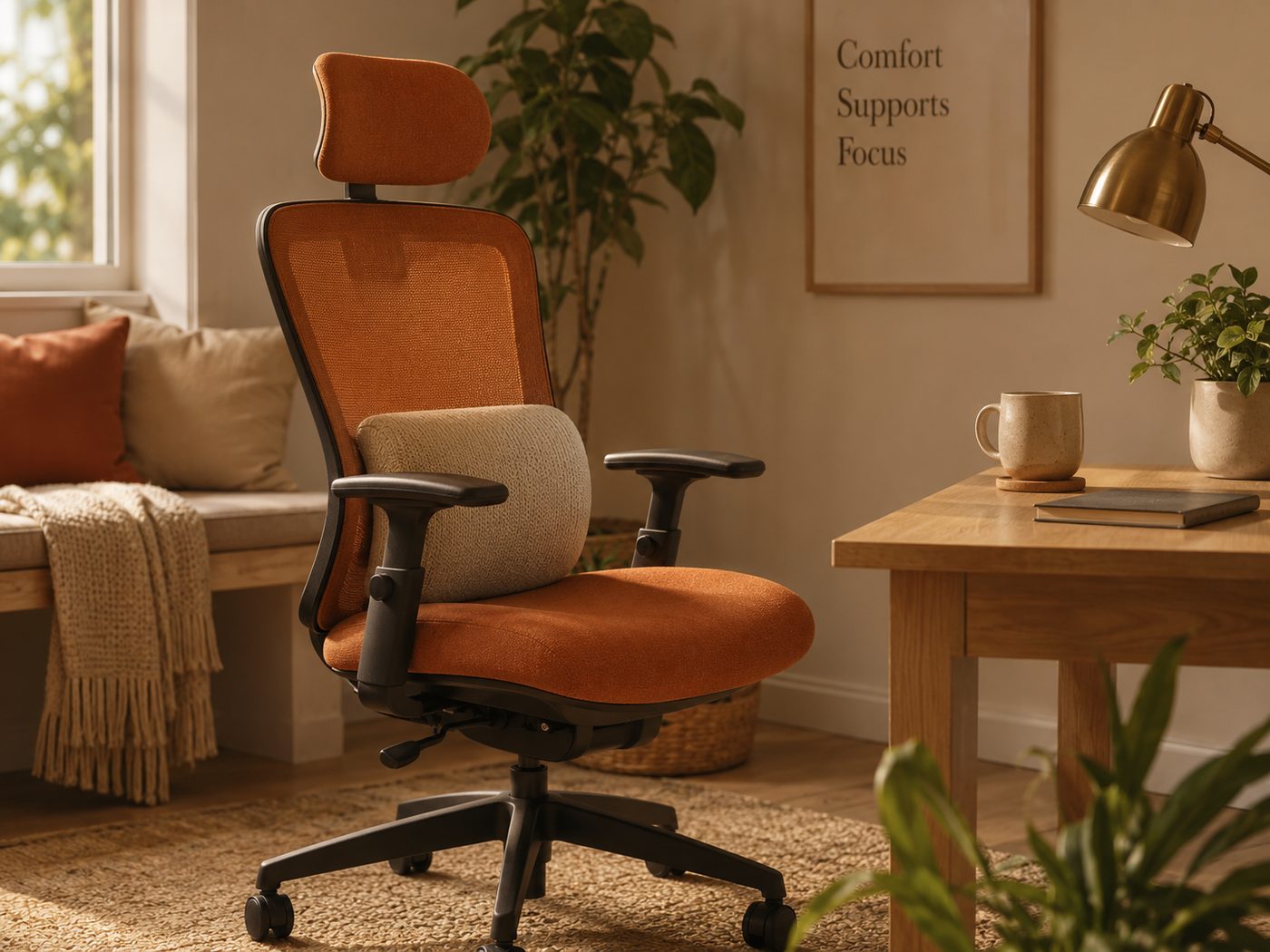
There's a reason "cozy desk" searches on Pinterest are up 100% this year. People working from home — employees, freelancers, anyone running their own thing from a kitchen table or a spare room — are done with the sterile, corporate-office look. They want a space that feels good to sit in, not just one that's functional.
The tricky part is that "cozy" and "ergonomic" sound like they pull in different directions — soft and warm versus supportive and structured. They don't have to. A few of the right pieces give you both: real back support for a full day of work, styled in a way that fits a room you'd actually want to spend time in.
Start here: the chair itself
1 An Upholstered Ergonomic Chair
You don't need a black mesh gaming-style chair to get real lumbar support. Several brands now make upholstered task chairs — fabric or boucle-style seats, curved wood or brass legs — that give proper back support while actually matching a living-room-adjacent home office.
- Adjustable lumbar support built in, no add-ons needed
- Looks like furniture, not office equipment
- Highest price point on this list
- Fabric seats need occasional cleaning
View on Amazon →
2 Memory Foam Seat Cushion
If a new chair isn't in the budget right now, this is the cheapest fix that makes the biggest difference. A U-shaped memory foam cushion relieves tailbone pressure on almost any chair you already own — and most come in colors that don't scream "medical device."
- Works on dining chairs, desk chairs, even car seats
- Best comfort-per-dollar on this list
- Doesn't fix back/lumbar issues — pair with #3
- Can compress over 1–2 years and need replacing
View on Amazon →
3 Lumbar Support Pillow
Lower back pain from sitting is usually a lumbar-support problem, not a "you need a $900 chair" problem. A memory foam or buckwheat lumbar pillow that straps to your existing chair fixes most of it. Look for one in a neutral linen or boucle cover rather than the standard black mesh.
- Directly addresses the most common desk-chair complaint
- Needs repositioning if you shift posture a lot
View on Amazon →
Small additions that make it feel like your space
4 A Throw Over the Chair Back
Simple, cheap, and it instantly softens even a plain office chair. Faux fur or a chunky knit both work — drape it over the back for cooler months, or keep it on your lap during a long call.
- Cheapest visual upgrade on this list
- Can slide off smooth leather/vinyl chairs
View on Amazon →
5 A Small Area Rug Under the Desk
A rug grounds a desk area the same way it grounds a living room — and it's a lot warmer on bare feet than hardwood or tile in the winter. Doesn't need to be big; just enough for your chair to roll on.
- Warmth plus visual definition of the "work zone"
- Get a low-pile rug or a chair mat on top — plush rugs make wheels stick
View on Amazon →
6 An Adjustable Footrest
If your feet don't rest flat on the floor when your screen is at eye level, a footrest closes that gap. It's a small posture fix that a lot of people skip, and it noticeably reduces leg fatigue by the end of the day.
- Fixes leg fatigue that cushions/pillows can't touch
- Adds another item under the desk — measure your leg room first
View on Amazon →
For when you need to get up from the desk (without leaving the room)
7 A Second, Softer Seat
A small armchair, papasan, or even a floor cushion in the corner gives you somewhere to take a call, read something, or just sit that isn't your desk chair. Having a second spot in the room makes it easier to actually change position during the day instead of staying glued to one seat.
- Encourages real posture breaks, not just a stretch at the desk
- Needs floor space you may not have
View on Amazon →
8 Heated Seat Cushion
If your office is the coldest room in the house (very common — spare rooms and converted corners usually are), a low-wattage heated cushion is a small comfort upgrade that a space heater can't match for your actual body.
- Cheaper to run than heating the whole room
- Corded — check cord length reaches your outlet
View on Amazon →
The honest starting point
If you only do one thing from this list, get the lumbar pillow (#3) or the seat cushion (#2) before anything else — they're the cheapest and they fix the most common source of desk-chair discomfort. A full chair (#1) is worth it once you know you're working from home long-term; everything else on this list is about making the space feel like yours, and that part can happen gradually.
FAQ: what people usually ask
Cushion or a new chair — which actually matters more?
For most people, a lumbar pillow plus a seat cushion fixes 80% of what a $400 chair fixes, for under $60 combined. A new chair matters more once your existing chair has no adjustability at all (fixed height, no lumbar curve) — at that point, cushions are working around a bad base.
How do I know if my chair is actually the problem vs. my desk height?
Sit normally and check three things: feet flat on the floor (or on a footrest), elbows roughly level with your desk, and your lower back touching the chair back without leaning forward. If one of those is off, it might be desk/screen height rather than the chair itself — the laptop stand and footrest above address that.
Is it actually worth spending $300+ on an office chair?
If you're sitting in it 30+ hours a week for years, the cost-per-use is genuinely low — it works out to cents per day. If you're not sure you'll be working from home long-term, or you're on a tight budget right now, the cushion + pillow combo is the more reasonable starting point.
More cozy-but-functional finds
New picks get posted on Instagram alongside full guides.
Follow @stressfreeworkday